
£50m West Midlands R&D initiative launches to upscale and develop local businesses
6 July 2026
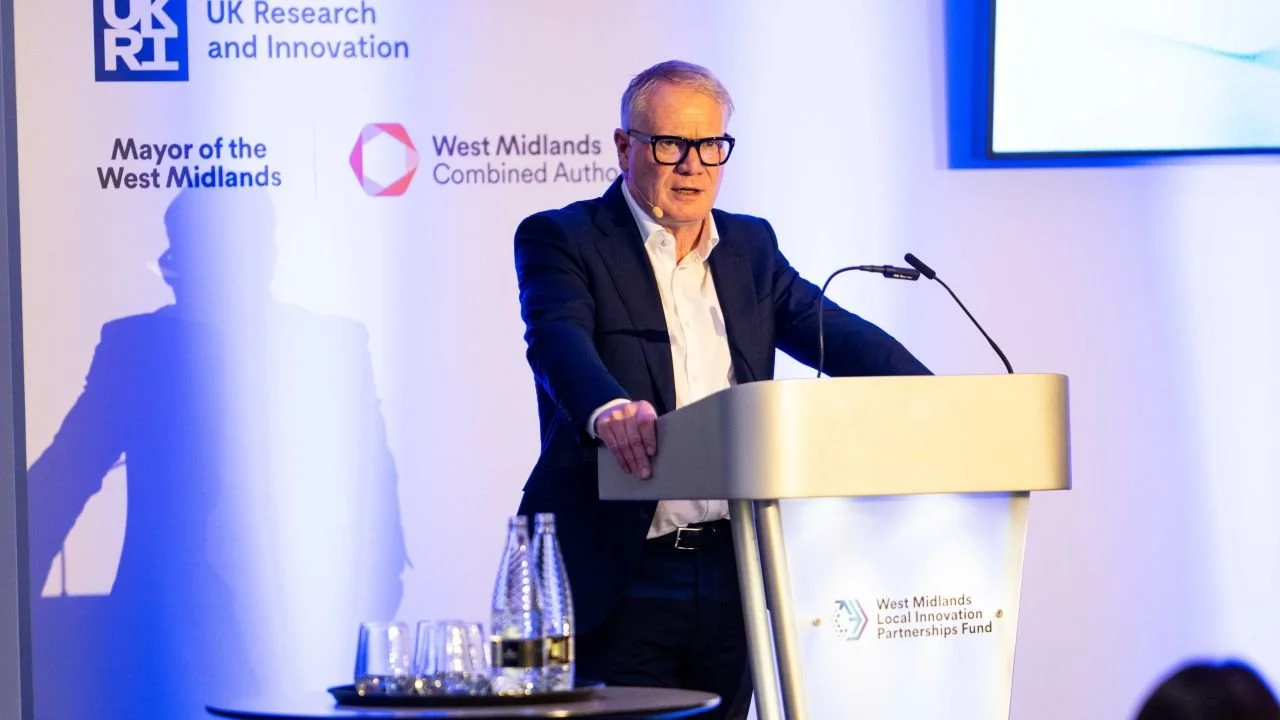
West Midlands Mayor Richard Parker
Three projects launched in the West Midlands are receiving £50 million of support from the Local Innovation Partnerships Fund to help businesses develop and scale near to market products and services.
Businesses operating in the high growth clusters of advanced manufacturing, health and life sciences and creative technology can now submit expressions of interest (EOI) for research and development funding support from the £50 million allocated to the West Midlands through the UK government’s £500 million Local Innovation Partnerships Fund.
Led by UK Research and Innovation (UKRI), the national Local Innovation Partnerships Fund is designed to support the development and scaling of high-potential, existing and emerging innovation clusters across the UK.
It brings together local leaders, businesses and research organisations to build on regional strengths; creating high-quality jobs, driving innovation-led productivity, and attracting additional public and private investment into communities nationwide.
The clusters prioritised for this funding were announced by West Midlands Mayor Richard Parker earlier this year. A formal launch, attended by the Mayor, Lord Vallance, Minister for Science, Innovation, Research and Nuclear, and Mike Wright, Chair of the West Midlands Innovation Board, was held in Birmingham on Friday 3 July to mark the next phase of delivery.
These projects will support the West Midlands Growth Plan and will help unlock more than £200 million in private capital and create a £700 million long-term economic legacy in the region. They will also support the Growth Plan’s ambition to grow GVA by £17 billion by 2035, and create 100,000 high-quality jobs.
Following the launch, Lord Vallance visited the new laboratory for the Aston Institute for Membrane Excellence (AIME) at Aston University and Birmingham Health Innovation Campus (BHIC) while in the city.
Richard Parker, Mayor of the West Midlands, said:
“Our track record of investing in the right ideas at the right time has already created hundreds of jobs and attracted millions in private investment. Government is now backing us to do even more through this record innovation funding deal.
“These research labs and tech studios are as important to our economy today as the factories of previous generations that made the West Midlands the ‘workshop of the world’.
“We’re determined to cement our role as a global leader in the industries of the future by backing a new generation of innovators and pioneers to turn their big ideas into commercial success.”
Lord Vallance, Minister for Science, Innovation, Research and Nuclear, commented:
“Innovation is fundamental to achieving economic growth, which is why we want to support the development of new tech right across the country, including here in the West Midlands. These projects will help secure the region's status as an engine for growth in advanced manufacturing, health and life sciences, and creative technologies – with the local partnership expecting to deliver more than 2,300 skilled jobs and helping unlock more than £180 million in private investment.
“The Local Innovation Partnerships Fund is ensuring the expertise we have right across the country is playing an active role in shaping the future of our economy and in cementing our position as a world leader in science and innovation.”
LIPF is open to innovative organisations of all sizes based in the West Midlands, including startups, scale-ups, SMEs, large companies, and research organisations. Eligibility is driven by the active role the organisation plays in developing, commercialising, or scaling technologies within the three priority sectors. Businesses must also be part of a “triple helix” partnership – a collaborative network between private industry, academic research partners, and the public sector.
Funding will be delivered across three flagship innovation programmes, including;
FORGE for Advanced Manufacturing: Led by the University of Warwick, the FORGE project will drive technology-enabled industrial transformation and supply-chain agility across future mobility and the clean energy transition.
Clinical Trials Catalyst for Health and Life Sciences: Led by the University of Birmingham, the WM Clinical Commercial Catalyst strengthens regional expertise in clinical trials, and near-to-patient biomanufacturing and regulation, leveraging regional strengths into global markets.
Creative Industries Scale-up Lab (CISL) for Creative and Immersive Technologies: Led by the University of Warwick, WM CISL targets a fast growth regional opportunity in immersive, AI-enabled and design-led innovation, diffusing adoption, with skills and market pull across multiple areas.
These projects have been co-developed by the West Midlands Combined Authority (WMCA) and the West Midlands Innovation Board, in partnership with the Department of Science, Innovation and Technology (DSIT) and UK Research and Innovation (UKRI). The Fund will be delivered by the West Midlands Growth Company (WMGC) and Business Growth West Midlands (BGWM) alongside lead delivery partners University of Warwick and University of Birmingham.
All projects must involve academia, industry and government, and deliver real-world impact, advancing knowledge, improving lives and driving growth.
The West Midlands is one of seventeen places across the UK receiving support to deliver real-world impact, advancing knowledge, improving lives and driving growth.
Professor Sir Ian Chapman, CEO of UKRI, said:
“The Local Innovation Partnerships Fund exists to ensure that world-class research gets into the hands of local organisations and businesses to create real economic value in communities across the UK.
“The West Midlands is demonstrating exactly how that works: taking deep scientific expertise in areas like health and life sciences, and advanced manufacturing and connecting it directly to industry and global markets.
“This is how UKRI’s investment in places becomes investment in the nation’s future and helps achieve our mission to advance knowledge, improve lives and drive growth.”
In the West Midlands, LIPF builds on the success of the £43m West Midlands Innovation Accelerator, which supported over 1,500 local businesses and generated more than a 2:1 private co-investment rate within three years. The initiative supported business such as the Global Nano Network, FuturEnergy, Osmium, and MICA Biosystems.
Mike Wright, Chair of the West Midlands Innovation Board, a body established in 2019 that brings together businesses, universities, and policy makers and co-created the initiative to help innovative companies scale up, said:
“LIPF West Midlands represents an exciting continuation of the successful West Midlands Accelerator programme. This £50m public sector funding will help nurture and develop high-growth sector businesses, by translating great ideas into market-ready products and services.
“It will ensure we’re putting the West Midlands on the map as a national and international leader in business innovation, development, and technology.”
Following the LIPF launch, Lord Vallance formally opened the new laboratory for the Aston Institute for Membrane Excellence (AIME) at Aston University, which explores how membrane research from biological to materials science can be harnessed for breakthroughs in drug discovery, biomanufacturing and industrial processes such as water purification. The unique design of the new AIME laboratory brings together chemistry and biology research in one space, fostering collaboration and removing scientific barriers.
Lord Vallance then visited the Birmingham Health Innovation Campus (BHIC) and met with the leaders of the University of Birmingham and local MPs to discuss the critical role of Birmingham's Health & Life Sciences District, a square mile with a £1bn five-year cycle of new R&D awards, in attracting inward investment and scaling SMEs within the UK. The visit highlighted the defining contribution of the University, surrounding healthcare partners, industry, Government and charitable funders to grow the region’s capacity, capability and commitment to deliver on the Life Sciences Sector Plan and NHS 10-Year Plan for patients, the public and our UK economy.
Wider academic partners in LIPF include Coventry University, Aston University, Birmingham City University, and the University of Wolverhampton. Wider private sector, cluster, and industry partners include the Black Country Industrial Cluster (BCIC-WM), Midlands Aerospace Alliance (MAA), Jaguar Land Rover (JLR), the Primary Care Accelerator, Medilink Midlands and RESILIENCE, BBC, Banijay, Create Central and CWX partners, Cisco, and Capgemini.
Businesses can now register an expression of interest in the Local Innovation Partnerships Fund.